Smart – Spacious – Stylish. The British branch of the Czech carmaker Škoda Auto released a cute video this summer teaching Brits how to pronounce the word “Škoda.” They did a great job, of course, but I think they’d be quite surprised to learn that the word “Škoda” means “damage.” Who would have thought to give a successful car company such a strange name?
The reason is simple, but not entirely actually, because three names come together in the story: Emil Škoda (1839 – 1900), Václav Laurin (1865 – 1930), and Václav Klement (1868 – 1938).
Emil Škoda, a Great Visionary From Pilsen
The West Bohemian city of Pilsen (in Czech, Plzeň) is historically known primarily for two industries: engineering and brewing. Emil Škoda was involved in both. A visionary and a man of great ideas and bold plans. His story is not that of a poor student who achieved success through immense diligence and self-denial. It is the story of a man who started with a strong foundation (his father was a doctor and a member of the Austrian Imperial Diet. His uncle was a professor at the medical faculty of the University of Vienna who treated many prominent figures of the time, including the Rothschild family), who worked his way to success primarily through diligence, an unshakable belief in his vision, the courage to try new things, and tough principles. For all these reasons, he is still considered one of the fathers of modern management.
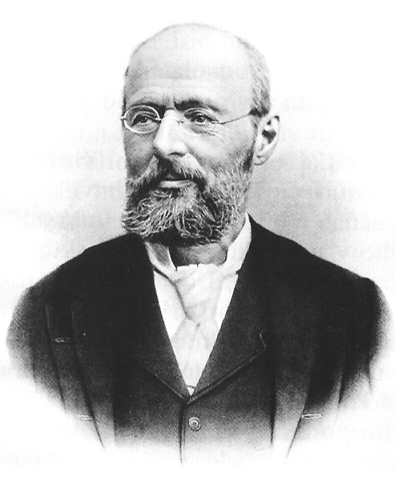
Although his entire family hoped he would become a doctor, he insisted on pursuing a technical field. He first studied at the Czech Technical University in Prague, one of the oldest technical universities in the world (the school was founded in 1707), and at the Karlsruhe Institute of Technology. After completing his studies, he gained experience in France, England, and the United States. He also spent time in Prussia, from which he was, however, expelled after the outbreak of the Prussian-Austrian War in 1866. He considered himself a Czech German, or possibly an Austrian. At the time of his birth, we were part of the Austrian Empire, and at the time of his death, part of Austria-Hungary. Thus, while in Prussia, he was a citizen of an enemy state. He was given 48 hours to leave.
In 1866, Emil Škoda took his first full-time job—he became chief engineer at Count Waldstein’s engineering works in Pilsen. And because he was a visionary and knew that high-quality steel would start to move the world, he began urging the count to modernize and significantly expand the business. The count did not want to do anything like that and eventually sold his engineering works to Škoda. The price was 167,642 guldens, and since the young engineer had an annual salary of 1,500, this was the equivalent of 111 years’ worth of his salary. It’s easy to conclude from this that he certainly didn’t lack courage.
To purchase the company and fund its further development, Emil had to borrow money from his family, extended relatives, and others who believed in his vision. In total, he raised 1.4 million guldens in this way. He began building a foundry, a forge, a machine shop, a steel mill, and an arms factory.
To be as close to the factory as possible, he rented a room where he could see the factory out his windows. The room was in the house of Marie Hahnenkamm, the widow of Johann Hahnenkamm. She owned several houses in Pilsen, a brewery, a brickworks, and a carriage business with 200 horses in her stables. She also had a nineteen-year-old daughter, Hermína, so what was to be expected, in the end, happened. There was a wedding, and Hermína’s dowry of one hundred thousand made it easier for Emil Škoda to launch his business according to his vision and ideas.
Starting with a workshop of 33 employees, he gradually built a factory with 4,200 workers and 200 members of management. He had lunches brought in from a restaurant for the workers so that mealtimes wouldn’t slow them down too much. He paid very well; the best workers earned over 500 guldens a year. He also built apartments for the workers, where long-time employees paid lower rent. But he was also known to beat them with a stick if he was dissatisfied with their work. Significant fines of up to five times the daily wage were imposed for various offenses, and proven theft resulted in immediate dismissal. When a law was passed reducing the workday to 10 hours, it sent him into a fit of rage, because he himself worked fourteen hours a day.
After all, stubbornness and strict discipline were his characteristic features. His daughter Josefina (the Škodas had three daughters and one son in all) once lamented: “I feel so alone, and I can’t help it. Things are terrible at home, after all. Because there is a lack of love in almost everything and in everyone. The only people I can talk to are the servants.”
The Škoda factory, known as Škodovka, soon became one of the largest industrial plants in the country. It manufactured machinery and equipment for bakeries, brickworks, sawmills, mines, steel mills, sugar refineries, breweries, distilleries, and paper mills, as well as bridge structures. Pilsen soon became a destination for shipbuilders, both commercial and military. The arms industry gradually formed to account for a significant part of production. Machine guns, cannons, ammunition, and many other types of military equipment were manufactured here.
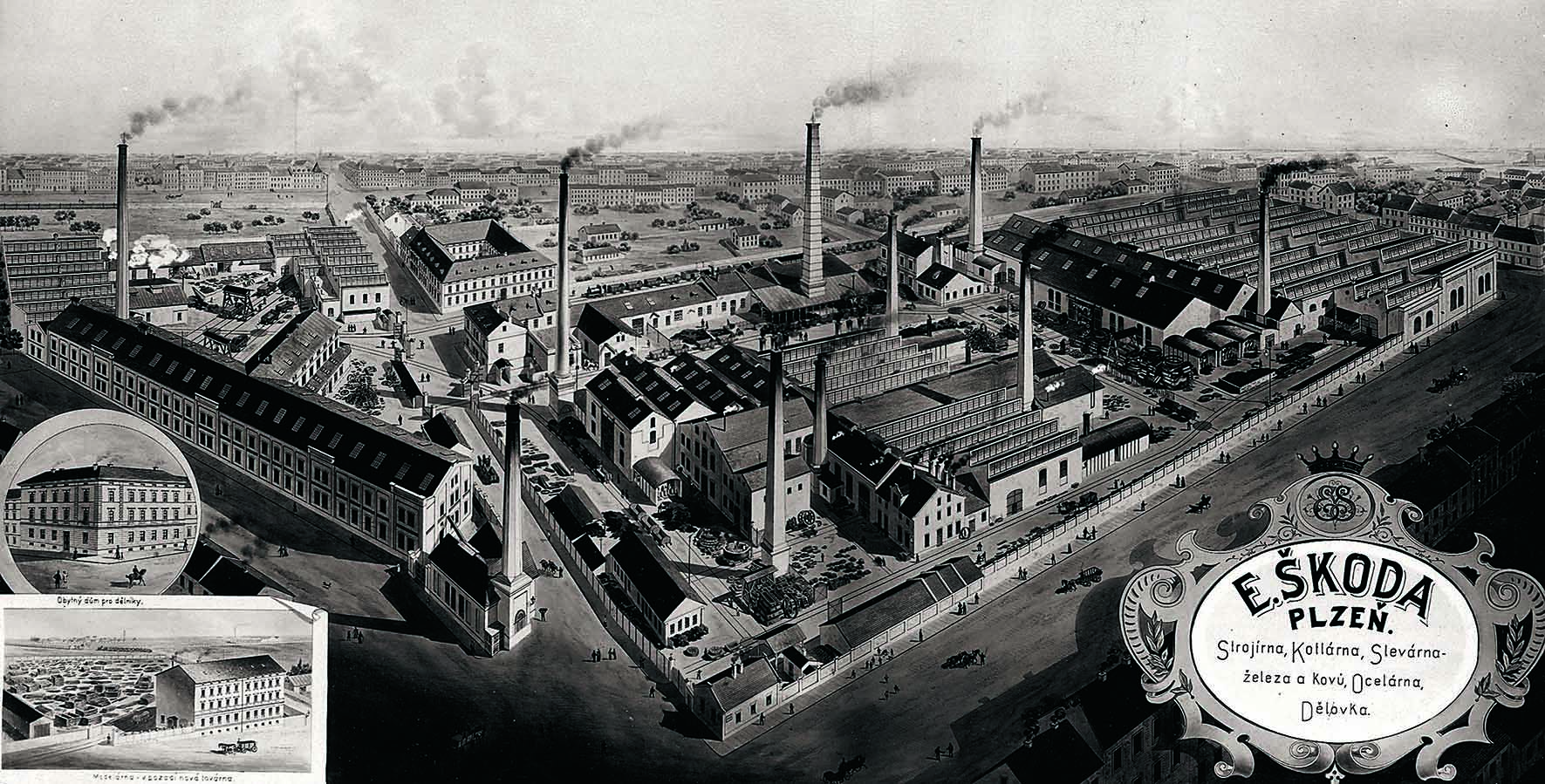
Škoda plants in their heyday (photo)
The historic factory buildings are now home to the Techmania Science Center
The quality did not decrease with the size of the company. In the case of the steelworks, Emil Škoda benefited from his experience in the U.S., where steel was hardened using nickel and chromium additives. As a result, his steel was the best in all of Europe. He thus had only one real competitor on the continent: the Krupp Works in Essen, Germany.
The paths of life of these two dominant steel producers crossed in a very specific way after Emil Škoda’s death. The heir to the Krupp empire, Alfried Krupp von Bohlen und Halbach (1907–1967), took over industrial enterprises in occupied countries during the war, including the Škoda Works in Pilsen. He employed as many as 100,000 people in forced labor, including prisoners of war and concentration camp prisoners. And because arms production was a priority during the war, he was even able to establish one of his production plants directly on the grounds of the Auschwitz concentration camp, where camp prisoners worked for him. For this reason, he was also tried at the Nuremberg Trials; however, he was ultimately acquitted because his father, Gustav, had primary responsibility for the company at the time, and he could not be tried due to advanced dementia.
When asked about feelings of guilt in 1959, Alfried Krupp replied: “What guilt? For what happened under Hitler? No. It is regrettable, however, that the German people themselves allowed themselves to be so deceived by Hitler.” In 1947, the Cold War broke out, and a period of great confrontation between the West and the Soviet Union and its satellite states began, in which we were also unwillingly involved. Strong economic infrastructure and weapons programs were very important on both sides of the Iron Curtain, which is why Krupp’s companies flourished even after the war.
The effects of constant mental and physical strain gradually began to affect Emil Škoda. Fortunately, he realized in time – and pressure from the banks also contributed to this – that a large industrial enterprise could not depend on the decisions of a single person, and he transformed the company into a joint-stock company, Škoda Works. Just how far-sighted this move was became clear just a year later, when Emil Škoda died. He ended his remarkable life in the engineering industry in style; he died on a train while returning from a spa.
After Emil Škoda death, his son Karel took over the company’s top leadership, serving as CEO from 1909 onward. The company continued to grow, and by 1910 it already had 16,000 employees. Karel led the company until 1916 when, in 1919, he sold his shares. Over time, Škoda ran into difficulties, but it overcame them and became the second-largest arms manufacturer in Europe. Around 1930, the company employed 35,000 people. In 1945, like virtually everything else in several steps, it was nationalized – that is, stolen from its owners and placed under state administration. This situation was not rectified until after the Velvet Revolution of 1989.
Two Visionaries From Mladá Boleslav
As mentioned above, the Emil Škoda factory was called Škodovka. However, this word also has a commonly recognized meaning even with a lowercase “š” at the beginning – that is, “škodovka.” This is how all Škoda Auto models are referred to en bloc.
(photo)
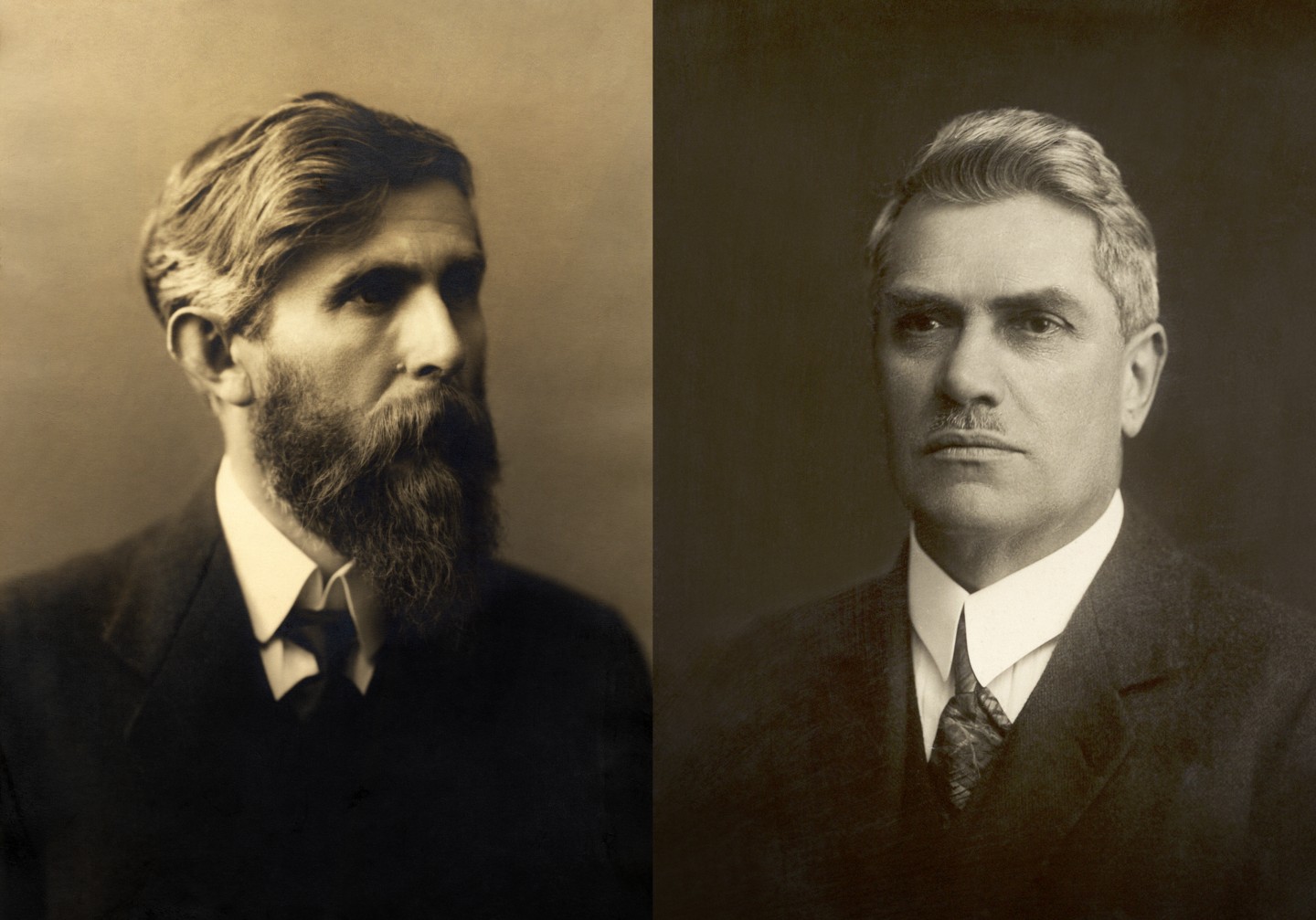
At the beginning of this story, in 1895, there were two young men. Václav Laurin, then thirty years old, and Václav Klement, three years younger. At that time, Klement filed a complaint about his Germania bicycle and received an arrogant reply: “If you want a response from us, we require that you communicate in a language we can understand.” That is, in German.
Václav Klement was a hot-tempered man, and this answer angered him, so he impulsively decided to start a bicycle manufacturing company. And since Václav Laurin had the same idea at the same time, they quickly agreed that they would not compete in a small town, but would do business together.
They named the company “Slavia,” a patriotic name. This is because, culturally, we are considered a West Slavic nation, and at that time it was not yet known that genetically the situation is much more complex. Genetically, the composition of the “average” Czech is: 33% Germans and Celts (they lived in our territory before the arrival of the Slavs), 35% Slavs, 10% Vikings, and 22% other nations. No wonder. The territory of the present-day Czech Republic has always been the center of Europe (geographically it is difficult to determine, but the astronomical center of Europe, i.e., the intersection of the 50th parallel and the 15th meridian, is located near the town of Kouřim, less than 30 kilometers from the eastern edge of Prague).
It’s worth taking a moment to reflect on our Celtic origins. That’s because they not only gave us our name, but also a characteristic health condition. You’ll find a great many Celtic landmarks in the area around the town of Beroun. It’s just a short drive west of Prague, and it’s definitely a good idea to go check it out.
The Celts came here in the 4th century B.C. and remained until roughly the 2nd–4th centuries A.D., when they were gradually displaced by the Germanic tribes. The most prominent Celtic tribe was the Boii, which is why our territory was called Boiohaemum. This name gradually evolved into Bohemia, or the Czech Lands. The Celts were diligent and hardworking; they were skilled craftsmen, builders, and artists. They were also capable warriors – so much so that even the Roman general, Julius Caesar tried to avoid conflict with them. The Celts were the first to use the following tools in our territory: shovel, pickaxe, scythe, mill wheel, saw, file, chisel, razor, hammer, pliers, drill, scissors, safety pin, padlock, or door hinges. They were also the first here to mint gold coins containing up to 97% gold, known as “rainbows”, since in later discoveries, people often found them in fields after the rain had washed them out. Or they found them glistening in the wet grass. The Celts are said to have invented pants. Another Celtic tribe, the Picts, continued to wear skirts, and the Scots adopted this custom from them.
“Celtic health indisposition” refers to the CFTR gene (cystic fibrosis transmembrane conductance regulator), which causes cystic fibrosis. A mutation in this gene, known as G551D, is found at a high frequency exclusively in the Czech Republic, parts of Austria, in Brittany, the United Kingdom, and Ireland.
Getting the new company off the ground wasn’t easy. Laurin and Klement insisted on high-quality materials and craftsmanship, which is why their bicycles cost as much as an average craftsman earned in a quarter. Business picked up when they offered installment plans with no markup – a practice they could afford because one of their dealers was a pawnshop. Three years after its founding, the company was no longer a workshop but a factory employing 32 workers and 3 office staff.
In 1898, they set out to develop their first motorcycle. And the ingenuity, tenacity, and persistence that characterized them served them well. To illustrate this, consider the story of how Václav Klement traveled to England with a business proposal. London’s most prominent merchant, Mr. Hawetson, made him an offer. If Václav could teach one of his employees to ride a motorcycle in five minutes, they could make a deal. Václav Klement managed it in three minutes, and ten minutes later he had an order for 150 motorcycles in his pocket.
In 1905, they began manufacturing their first automobile, called the Voiturette. And two years later, just as with Emil Škoda, the company was transformed into a joint-stock company. Later, both friends realized that they needed a strong strategic partner for further growth. This happened in 1925, and that partner was none other than the Škoda Works in Pilsen. The cars were no longer called Laurin & Klement, but Laurin & Klement–Škoda; the new models were simply called Škoda.
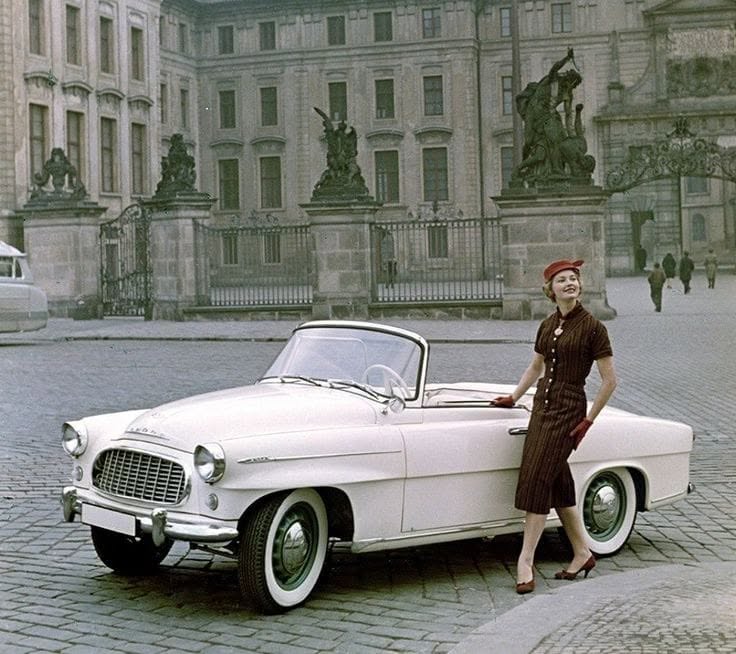
Shortly after being crowned Miss USA in 1957, Charlotte Sheffield accepted an offer to pose for a promotional photo shoot for Škoda Auto. The photographer was Vilém Heckel, a photographer and mountaineer who later died in 1970 during an expedition in Peru, where his mountaineering camp was buried by a rock avalanche at the foot of Mount Huascaran. The photograph shows Charlotte Sheffield in front of the Matthias Gate in Hradčany, posing with the very popular Felicia model. As soon as this photograph appeared in the U.S., Americans wanted to order 15,000 Felicias. However, only 408 were delivered. (photo)
Three Feathers on the Indian Headdress
The automaker’s logo, of course, continued to evolve from the original “Slavia” version. In 1905, a new logo was introduced featuring the founders’ initials surrounded by a laurel wreath, a symbol of success (this logo is still used today on Škoda’s luxury models). In 1925, the founders’ names receded into the background, and the name “Škoda” became the dominant feature of the logo.

The laurel wreath from the Klement and Laurin logo also appeared in a version of the Škoda Auto logo that was used from 1993 to 2011
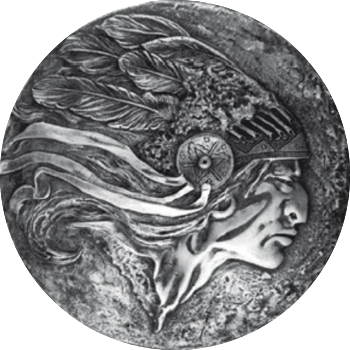
Two years earlier, Škoda in Pilsen began using a winged arrow in its logo, which remains the dominant symbol of Škoda cars to this day. The idea is said to have come from Tomáš Maglič, the sales director at Škoda in Pilsen, who was inspired to design the logo by a picture of a Native American that hung in his office. An arrow, with feathers from a Native American headdress above it; originally there were five, but the design with three eventually became standard. The professional rendering of his idea was reportedly the work of sculptor Otakar Španiel or Otto Gutfreund.
(photo)
The winged arrow thus appears in the logos of two companies today, and for neither of them does the word “Škoda” mean “damage”. (Škoda Auto has been part of the Volkswagen Group since April 1991 and is now its strongest brand in economic terms.) In June 2025, however, the Pilsen-based Škoda Group sold Škoda Auto the exclusive right to use the winged arrow; the Group itself will stop using it after 2029.
Václav Laurin and Václav Klement never met Emil Škoda; he had died 25 years before their business ventures came together. We cannot say for certain, but it is safe to assume that if these three visionaries and pioneers could see their legacy today, they would be very pleased. If they were to raise a toast to celebrate their successes, it would most certainly be with Pilsner beer—whether Pilsner Urquell or Gambrinus, a brand that Emil Škoda helped bring into being.
But more about that next time.