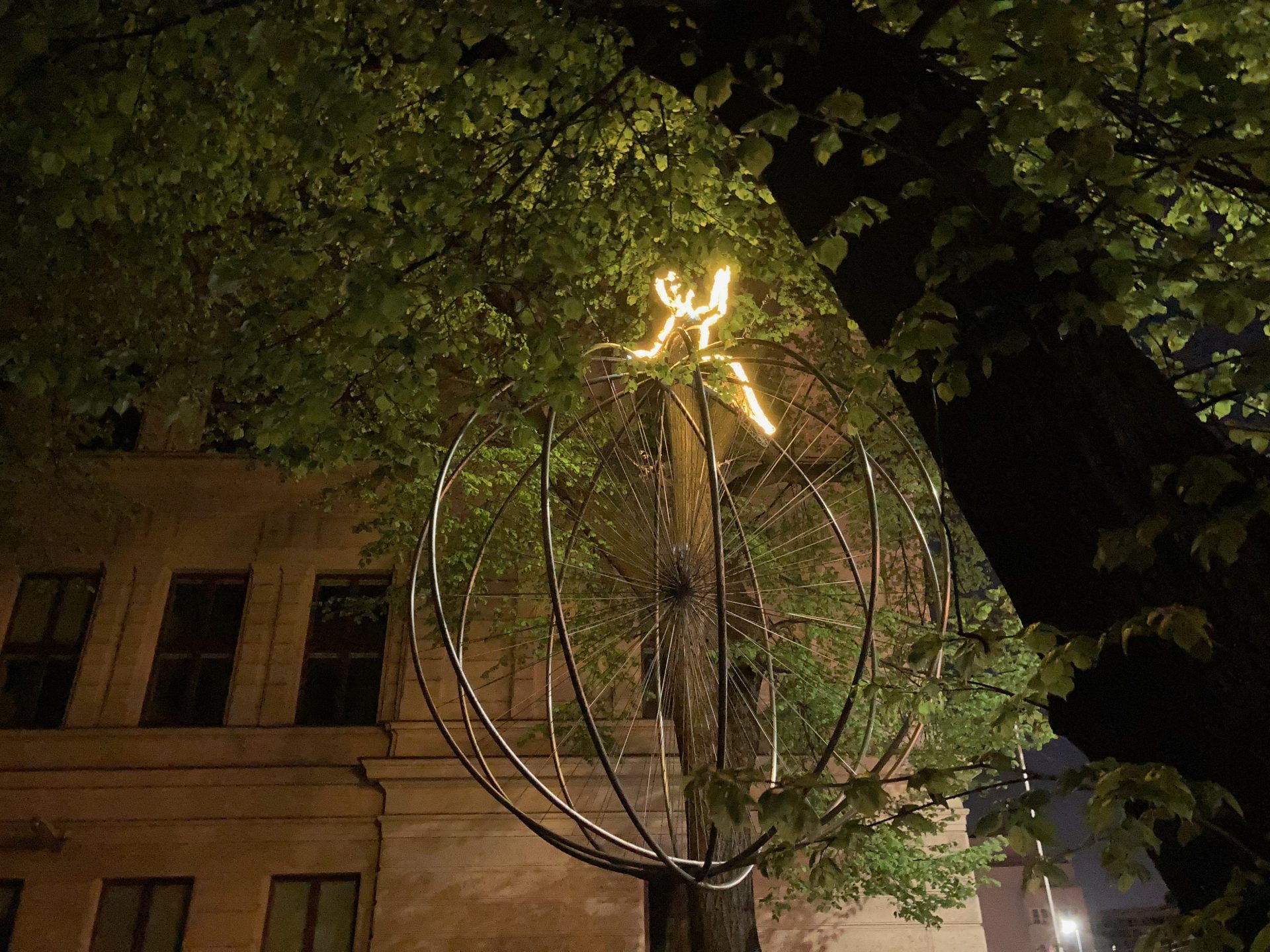
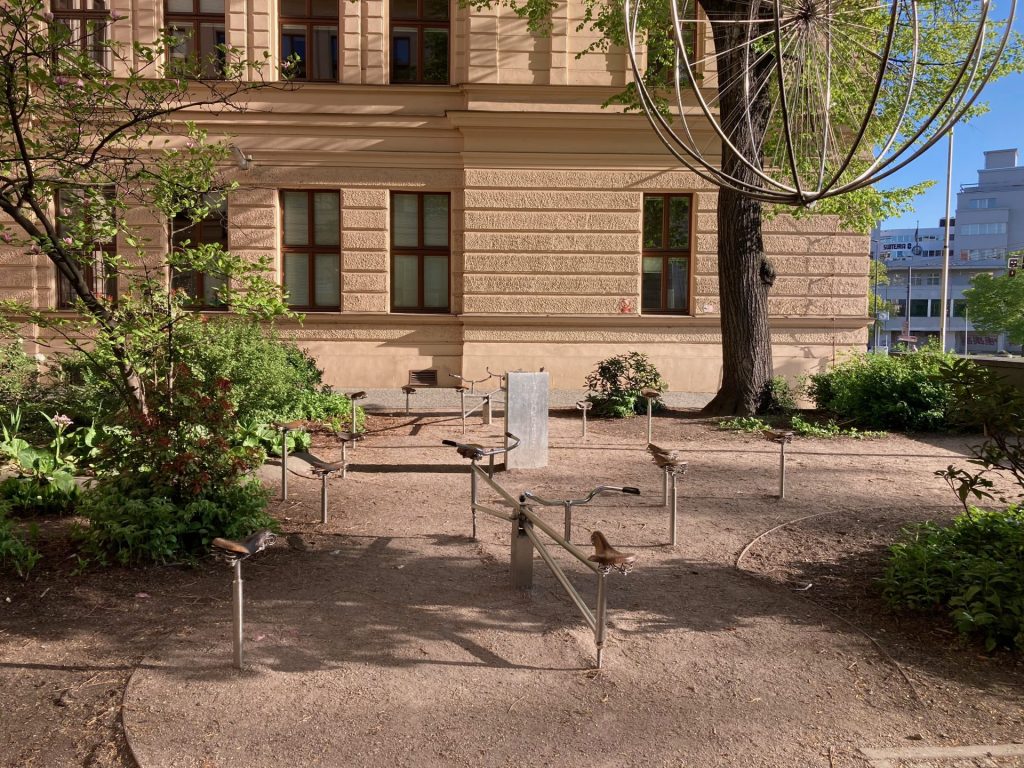
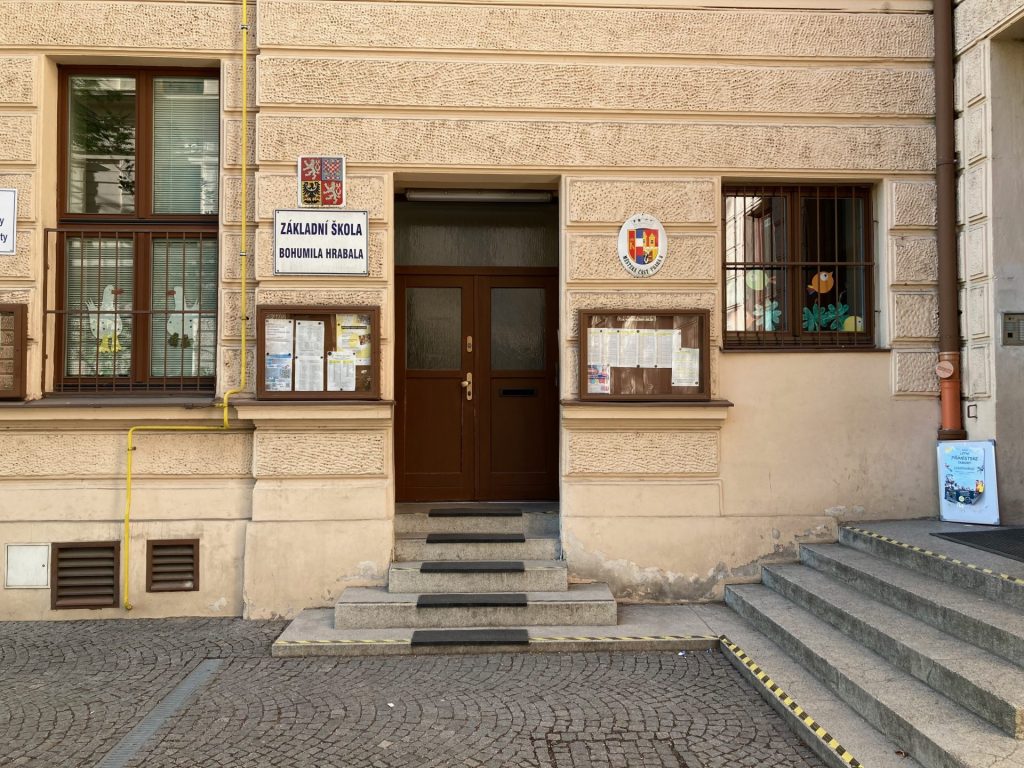
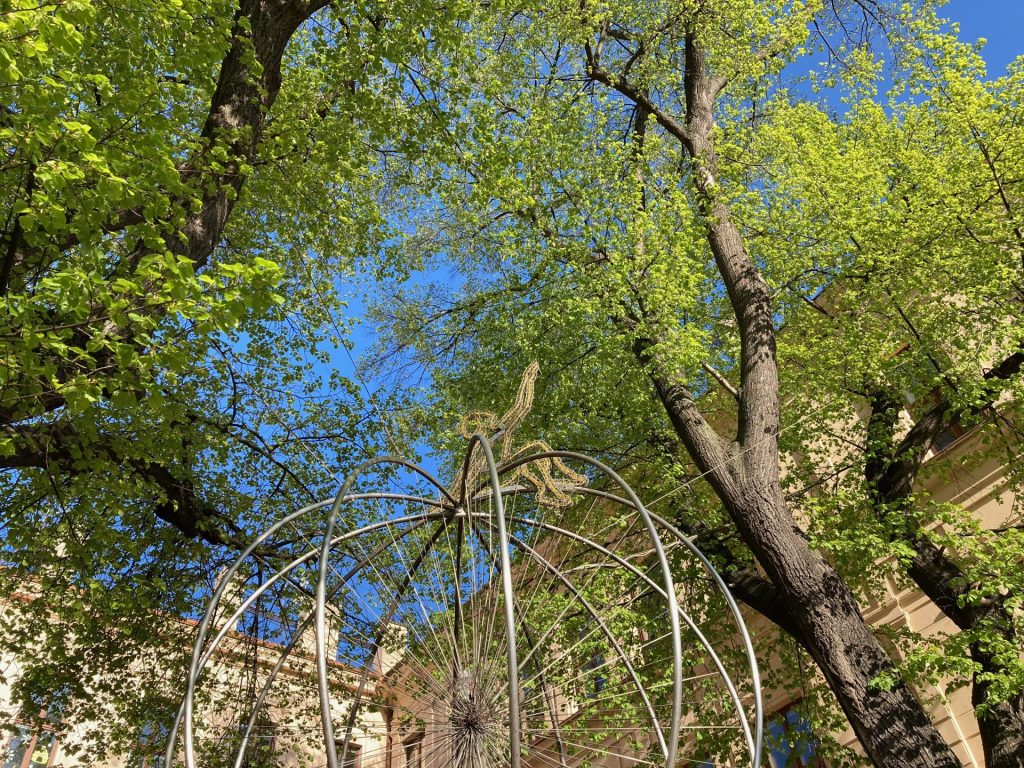
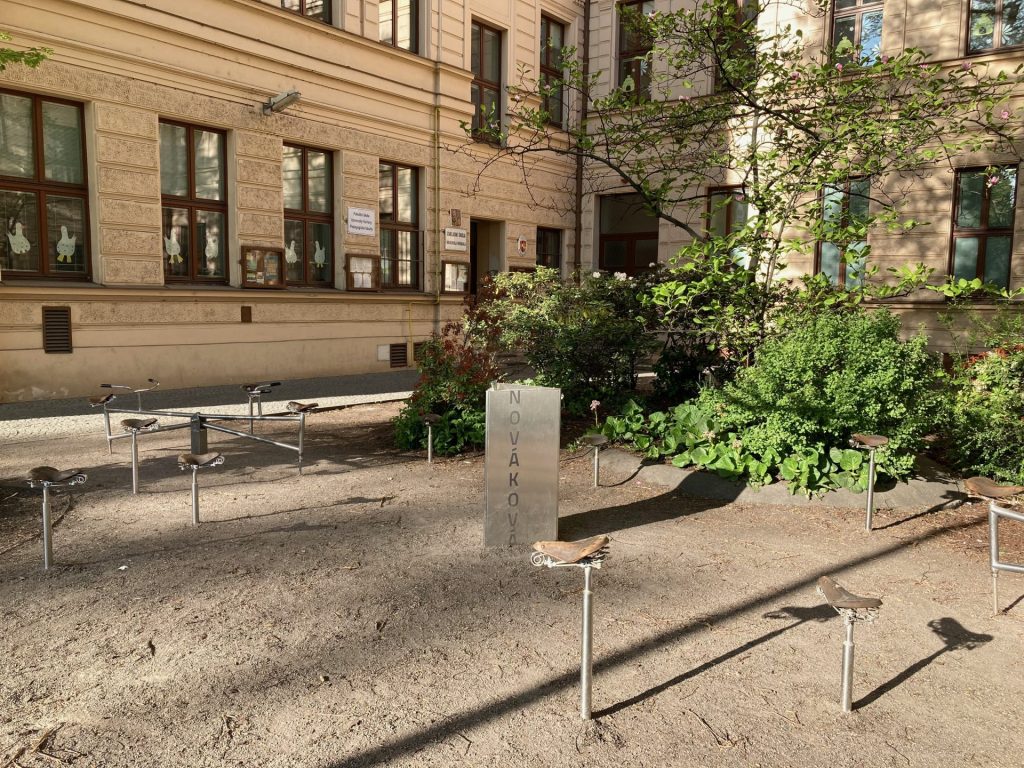
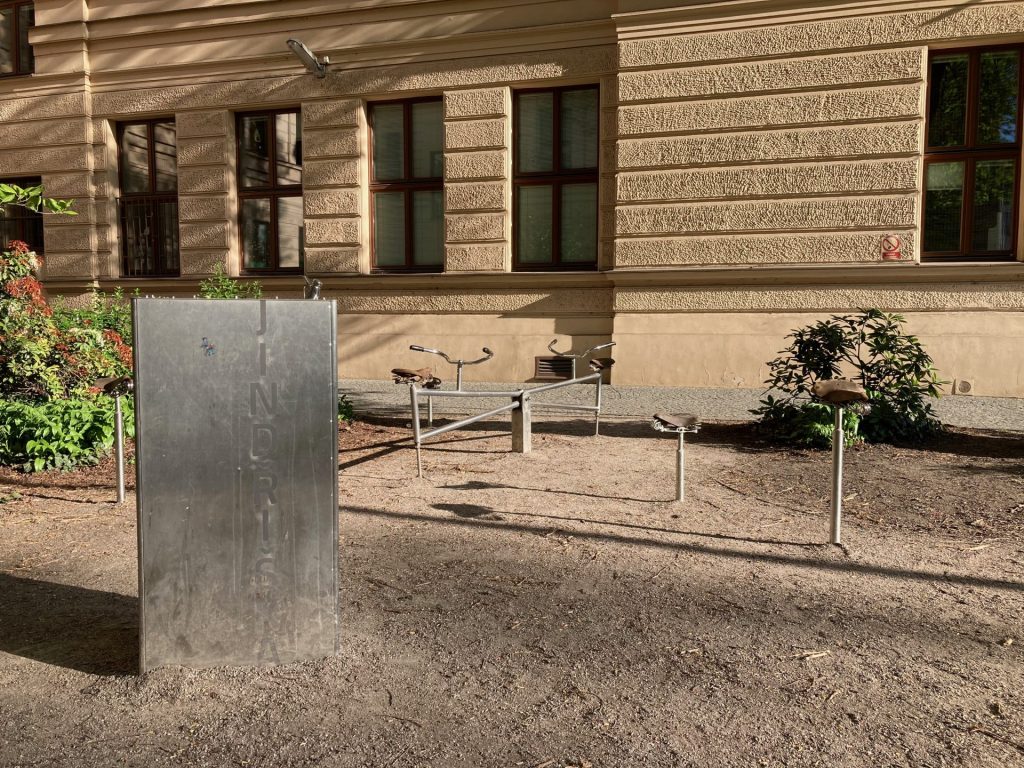
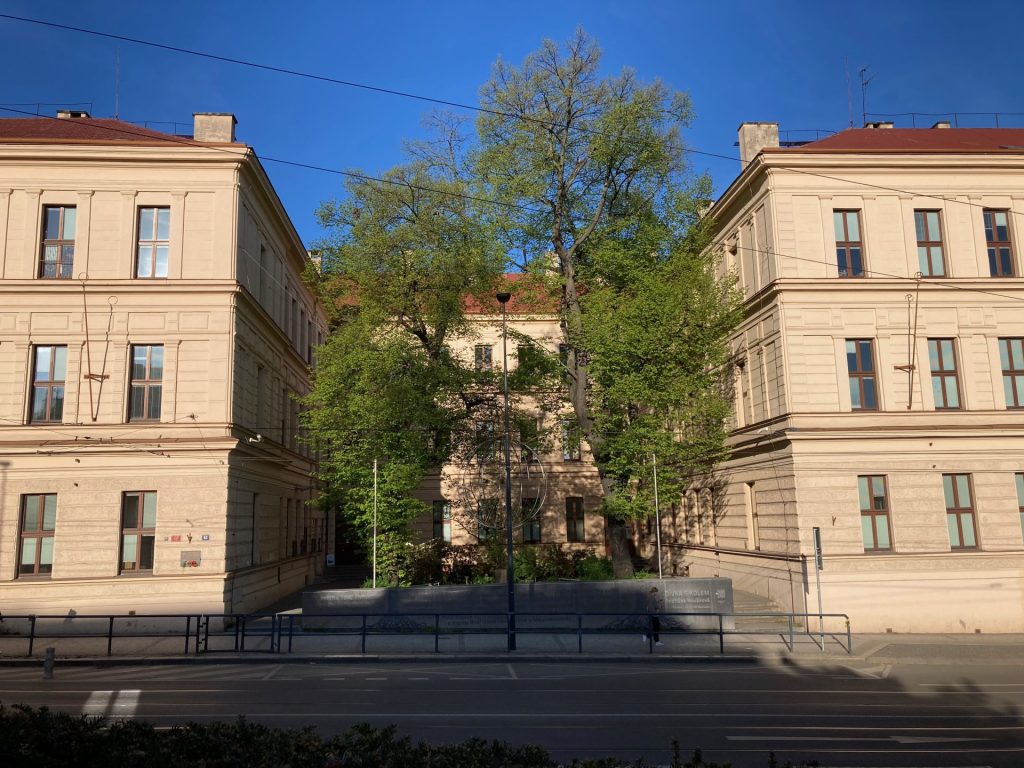
There is an unusual monument in the schoolyard of the Bohumil Hrabal Elementary School* in Libeň. Hanging from the tree branches are several wheels forming a sphere, where the silhouette of a girl is visible glowing at night. Below the sphere are several bicycle seats, representing bicycles ridden many decades ago. Feel free to have a seat or swing on one of them.
The monument is separated from the street by a stainless steel block with silhouettes of tree trunks that visually connect to the trees in the yard, and a sandblasted inscription:

On May 27, 1942, a fourteen-year-old student at this school, Jindřiška Nováková, left home early. Shortly afterwards, after the attack on the acting Reich Protector Reinhard Heydrich, a member of the Anthropoid group, Jan Kubiš, passed by this place and left his bicycle at the Baťa Store on Primátorská Street. At Jan Kubiš’s request, Jindřiška took the bicycle from the Baťa Store and hid it. For this act and helping the assassins, the Novák family, including little Jindřiška, was murdered in Mauthausen on October 24, 1942.
GIRL WITH THE BICYCLE
Jindřiška Nováková 6.5.1928 Praha – 24.10.1942 Mauthausen

The Novák parents, Marie and Václav (*1897 and *1893). In the top row from the left are their daughter Anna (*1919) and son Václav (*1921). In the bottom row Miroslava (*1925) and Jindřiška (*1928). On the far right is the eldest daughter, Marie. She was the only one not killed because she was married and no longer lived with her family.
Jindřiška Nováková
On May 27, 1942, Czechoslovak paratroopers Jozef Gabčík and Jan Kubiš carried out the assassination of Reinhard Heydrich. Jindřiška Nováková and her family are among the tens of thousands of Czech citizens, often nameless, who actively participated in the resistance against the German occupation. One of the paratroopers, Jan Kubiš, was hiding at her family’s house around the time of the assassination. He was injured after the assassination, but he still managed to cycle 2.5 kilometers from the assassination site to Libeň. He left his bike there, and Jindřiška Nováková later went to pick it up.
Unfortunately, she was noticed by Žofie Čermáková and Cecílie Adamová, women who saw an injured man arrive on a bicycle. Jindřiška claimed that the bicycle belonged to her father, who had had an accident. Both women, apparently ordinary gossipers without any initial malicious intent, unfortunately, told several neighbors what they had seen.
On the day of the assassination, martial law had been declared in Prague, which was later extended to the entire protectorate. Access roads to Prague were blocked, and extraordinary trials began within a few hours of arrest, where people were executed for any hint of consent to the assassination. Both witnesses became frightened and reported what they had seen.
On June 3, 1942, the Gestapo selected 260 girls aged 10-15 who lived within a 15-minute walk of the assassination site. They had to demonstrate how to ride a bicycle. Since the witnesses did not recognize anyone, the girls were taken to the Gestapo headquarters in Petschek Palace and were shown how to ride a bicycle again. Jindřiška Nováková was among the last ten, but she did not reveal herself. Neither of the pair of witnesses recognized her, or they didn’t want to recognize her.
However, the family ultimately did not escape the Nazis’ revenge. Jindřiška, her two sisters, her brother, and both parents were arrested only after Karel Čurda’s betrayal on July 9, 1942. They were all shot on October 24, 1942, in the Mauthausen concentration camp, with a bullet in the back of the head during a fake medical examination. Jindřiška was 14 years old at the time, and her execution was against the German laws enforced at the time. She was the youngest woman executed in Mauthausen. Only the eldest sister Marie survived, who had been in conflict with the family because she had married a German and lived with him in the Sudetenland, where the Novák family had been expelled from after the Munich Agreement in 1938.
Piskáček and Smrž Families
When the wounded Jan Kubiš reached the Novák family’s apartment, he asked Jindřiška to take away his bloodied bicycle, which he had left standing near the Baťa Store. Jindřiška took the bicycle and put it in the house’s courtyard. The bicycle was later picked up by Miroslav Piskáček, the son of other paratrooper collaborators.
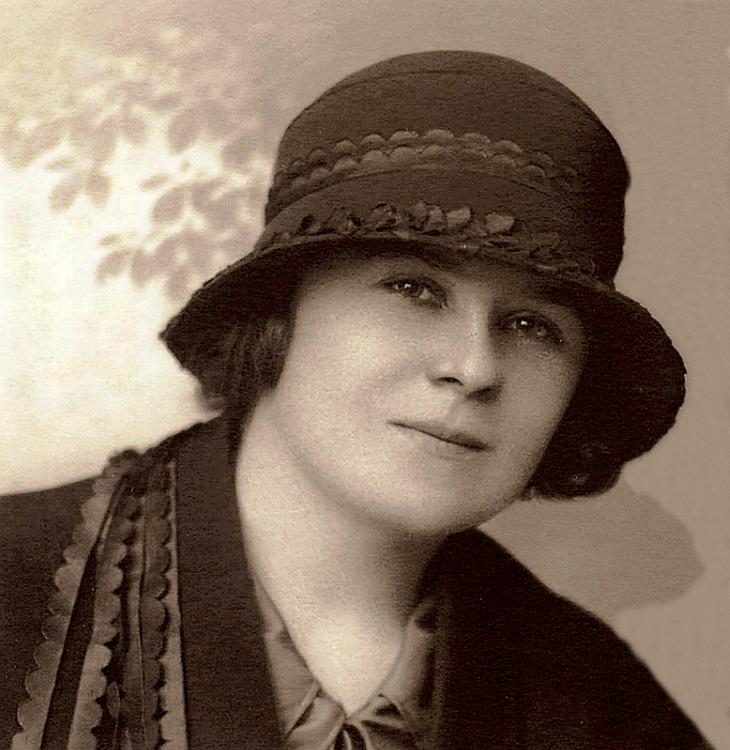

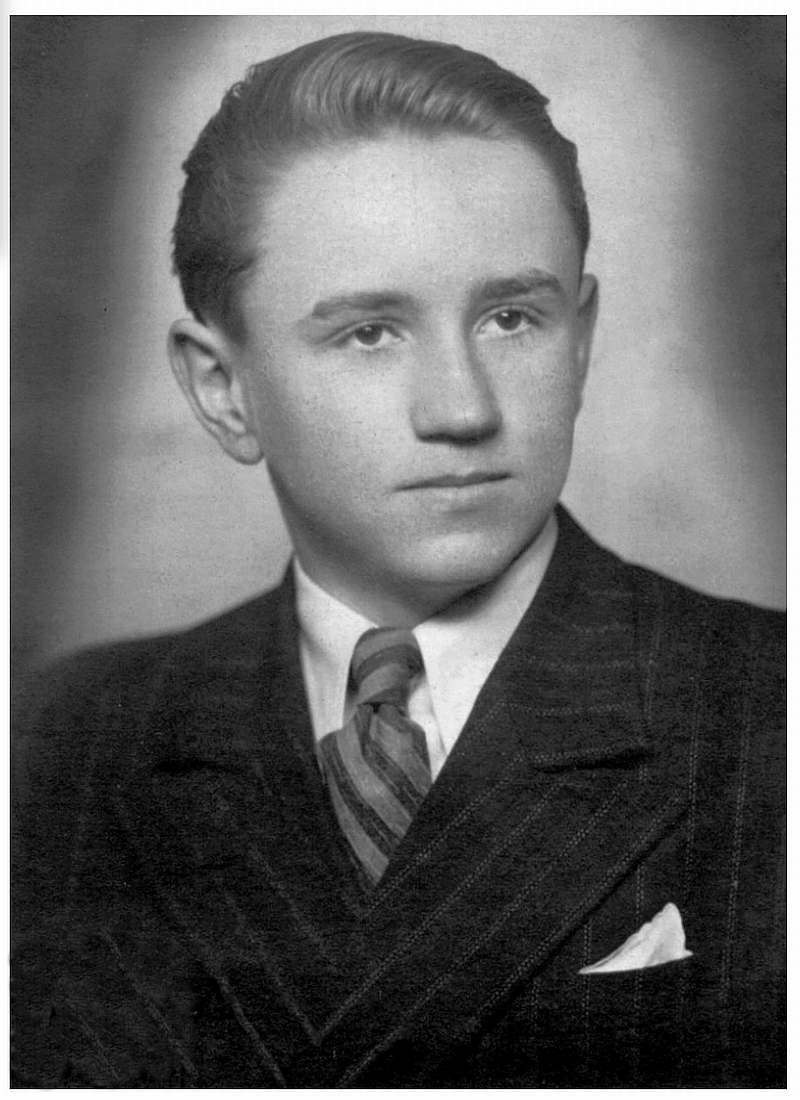
Both his parents, Antonie and Jaroslav, were members of Sokol and the Czech resistance, and participated in helping the Anthropoid paratrooper group. Its members were Jozef Gabčík and Jan Kubiš, who already understood when planning the super-secret operation in England that it would most likely be a suicide mission. Not only their son Miroslav, who was fifteen at the time, was involved in the resistance activities of the Piskáčeks, but also Antonie’s mother, Anna Hrušková, who procured ration coupons. **
Miroslav Piskáček took the bike to its owner, Jaroslav Smrž. He, his wife, and other members of the extended family were also involved in helping the paratroopers. They hid them and provided them with food. Or they helped hide the parachutes the paratroopers jumped into the occupied homeland with. They hid them in a child’s coffin and, using false death certificates, staged the child’s funeral in the cemetery in Ďáblice. The parachutes remained “buried” there until the end of the war, and today they are part of the exhibition in the Army Museum.
The Smrž couple was also shot on October 24, 1942, in Mauthausen.
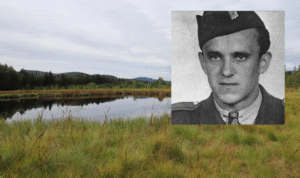
Karel Čurda
Karel Čurda was a member of one of the paratroopers drops who jumped into the territory of the Protectorate of Bohemia and Moravia in the first half of 1942 (his Out Distance landing took place on March 27, 1942).
Before the war, he was perceived by his commanders in Czechoslovakia as: “Temperamental and sincere in nature. Capable and understanding, diligent and persistent (report from 1934). Sincere, cheerful, diligent, persistent. Reliable, decisive, initiative (1936).”
In May 1946, Anna Kychlová, a Czech woman living in France, who Karel Čurda went on vacation with in 1940 in Moulins-sur-Allier along with her family, wrote to the Czech court: “And now I ask you, but also I ask myself, if it is possible that the man who, with tears in his eyes, begged me to teach my son better Czech, betrayed me. He told me then. “We will all lay our lives on the altar of the homeland, but our republic must be saved.” In the memory of his mother, he swore revenge on everything that was German!”
The story of Karel Čurda, originally a soldier and patriot, is the story of a man whose name became synonymous with betrayal. Thousands of people died because of him (often at the shooting range in Kobylisy), and the villages of Lidice and Ležáky were burned down, yet the story is not entirely clear-cut.
Mainly because the paratroopers could not have been prepared for the terror unleashed by the German repressive apparatus after the assassination of Heydrich, nor for the willingness of Czech informers. This in no way diminishes his guilt, with the worst consequences for most people. However, he was not the only one who could not hold out after the jump to his homeland.
It is hard to imagine today. Paratroopers jumped into their homeland, which was extremely dangerous for them. They often jumped dozens of kilometers from places where they had addresses of people who could help them (Čurda’s landing party deviated by 130 kilometers during the jump). Some were injured during the jump. And they knew that they could not just knock on anyone’s door and ask for help. And it did not always have a happy ending, as in the case of one landing party in April 1944.
Two police officers on bicycles, Jaroslav Šlechta and Ladislav Jakobe, saw a strange foursome of men in long coats, with hats and backpacks on their backs. After asking “Who are you and where are you going?” they received a surprising answer. One of the men told them that they had fallen from the sky and needed help, not complications. And he added: “Look, gentlemen, don’t ask us any more questions. If you keep quiet, we will keep quiet too. Moreover, we have four weapons; you only have two. You didn’t see us at all.” The two frightened gendarmes agreed, showed them the right direction to the village they were looking for, and then wrote in their report on the progress of the service that it had gone without any problems.
When Karel Čurda separated from the other paratroopers, which was clearly a mistake, he hid with his mother in the village of Nová Hlína, where not only she but also three of his siblings were living. After pressure from his mother and sister and after news of arrested paratroopers, as well as dozens of executed people, among whom were many family members that had been hiding the paratroopers and whom Karel Čurda knew, he became increasingly afraid. That is why he decided to betray the cause a few days after the burning of Lidice. First with a letter that went unanswered, then with a personal statement to the Gestapo. People who witnessed his confession later described that he was shaking all over and was the first to assure himself that nothing would happen to his family. (In Nová Hlína, people still had a different opinion of Karel Čurda decades after the war. They considered him someone who, with his confession, saved the village from the fate of Lidice.)
After his betrayal, Čurda took German nationality, changed his name to Karl Jerhot, and married the German Maria Bauer, the sister-in-law of a Gestapo official. He apparently gradually became more and more distressed by his betrayal and the fear of the consequences, and became an alcoholic. On May 15, 1945, he turned himself in at the gendarmerie station, saying: “Whatever comes, let it come.” He was sentenced to death and refused to ask for mercy. He was hanged in 1947.
Girl With the Bicycle


Streets in Libeň and Vysočany were named after the Novák, Piskáček, and Smrž families in 2021. In September 2022, a monument commemorating her deed was unveiled in the courtyard of the school where Jindřiška Nováková attended.
The competition to create the monument was won by Lukáš Wagner, who said of his idea: “It should educate children on the one hand, and entertain them on the other. There was a requirement that the monument be modern. It is not standard in Central Europe. Most of the time it ends up with some bronze nonsense, which, I’m not saying is bad, but belongs more to the 19th century.”
With his artistic concept, Lukáš Wagner also points to Antoine de Saint-Exupéry’s The Little Prince: “I solve it so that the children are not in a cage. In addition to the bike, it is also inspired by Exupéry and the Little Prince. If you think about it, the Little Prince was really alone on that planet, just like Jindřiška could have been. Her mother told her to ‘take the bike away’, so she didn’t deal with it, but then she was all alone with it. In the concentration camp, the family was separated from each other. On the one hand, it is a paraphrase of the bike, and at the same time, the sphere is a planet made up of it.”


* Bohumil Hrabal (1914-1997) is one of the most prominent Czech writers. He is (after Karel Čapek and Jaroslav Hašek, author of The Fate of the Good Soldier Švejk) the third most translated Czech writer of the 20th century. His novella Closely Watched Trains was adapted into a film of the same name by director Jiří Menzel, which won the Academy Award for Best International Feature Film in 1968. Bohumil Hrabal lived in the street just a two-minute walk from this school from 1950 to 1973.
** A rationing system for food sales was introduced in the protectorate from October 1939. Gradually, tickets were also introduced to purchase clothing, soap, tobacco, fuel, and feed for livestock. And because the Germans were thorough, they also remembered that once a year, people could buy more sugar – when they were preserving fruit. Pregnant women were entitled to buy more cloth, and men from the age of 17 were allowed to buy shaving soap.