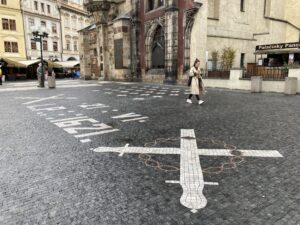
On the first Sunday after the establishment of the independent Czechoslovak state, the Marian Column was torn down in Old Town Square. The event was organized by the rebel and Bohemian Franta Sauer and presented as the overthrow of the symbol of the Habsburg monarchy. What does it matter that the column was erected in 1652 as an expression of gratitude to the Virgin Mary. Four years before that, in 1648, the last battle of the Thirty Years’ War took place, when the Swedish troops, who were trying to conquer Prague, did not fight their way into the Old Town and were forced to stay on the Lesser Town side of the river.
In response to the fall of the column, a plan was devised to build a ring of twelve Marian churches around Prague to atone for this injustice to the Virgin Mary. However, only three were built. The Church of the Immaculate Conception of the Virgin Mary in Strašnice, the Church of Our Lady, Queen of Peace in Lhotka, and the remarkable functionalist building of the Convent of St. Agnes of Bohemia and the Holy Patrons of the Czech Republic in Spořilov. There were plans for the other nine churches, but World War II and the communist coup in 1948 prevented this.
(The description “around Prague” is completely appropriate in the case of Strašnice, even though it sounds comical today. Today, Strašnice is the larger Prague area; you can reach Wenceslas Square by metro in eight minutes, but back then, Strašnice was a rural area. The first mention of Strašnice dates back to 1185, and in the 19th century, it was known primarily for growing cabbage. The village was incorporated into Prague in 1922.)
In 1924, the Association for the Construction of a Catholic Church in Strašnice was founded, and Mrs. Magdalena Sechtrová Škrábková donated the land for the church’s construction. In 1929, the Strašnice parish was established, and in 1930, architect Rudolf Sandholz drew up plans for the church and rectory. The project also included plans to place parts of the fallen Marian Column from Old Town Square in front of the church. However, the association did not accept this design. Probably due to a lack of funds. Only the rectory with a prayer room was built, as seen in the photograph.

In 1924, the Association for the Construction of a Catholic Church in Strašnice was founded, and Mrs. Magdalena Sechtrová Škrábková donated the land for the church’s construction. In 1929, the Strašnice parish was established, and in 1930, architect Rudolf Sandholz drew up plans for the church and rectory. The project also included plans to place parts of the fallen Marian Column from Old Town Square in front of the church. However, the association did not accept this design. Probably due to a lack of funds. Only the rectory with a prayer room was built, as seen in the photograph.
Following the communist putsch in 1948, believers and churches were persecuted, and building a new church was out of the question. However, efforts to build a church in Strašnice resurfaced during the Prague Spring of 1968, when the political situation eased. However, it did not take long, and after the beginning of the Russian occupation on August 21, 1968, these hopes were dashed once again. The Strašnice church had to wait for another turbulent period in our history: the Velvet Revolution of 1989.
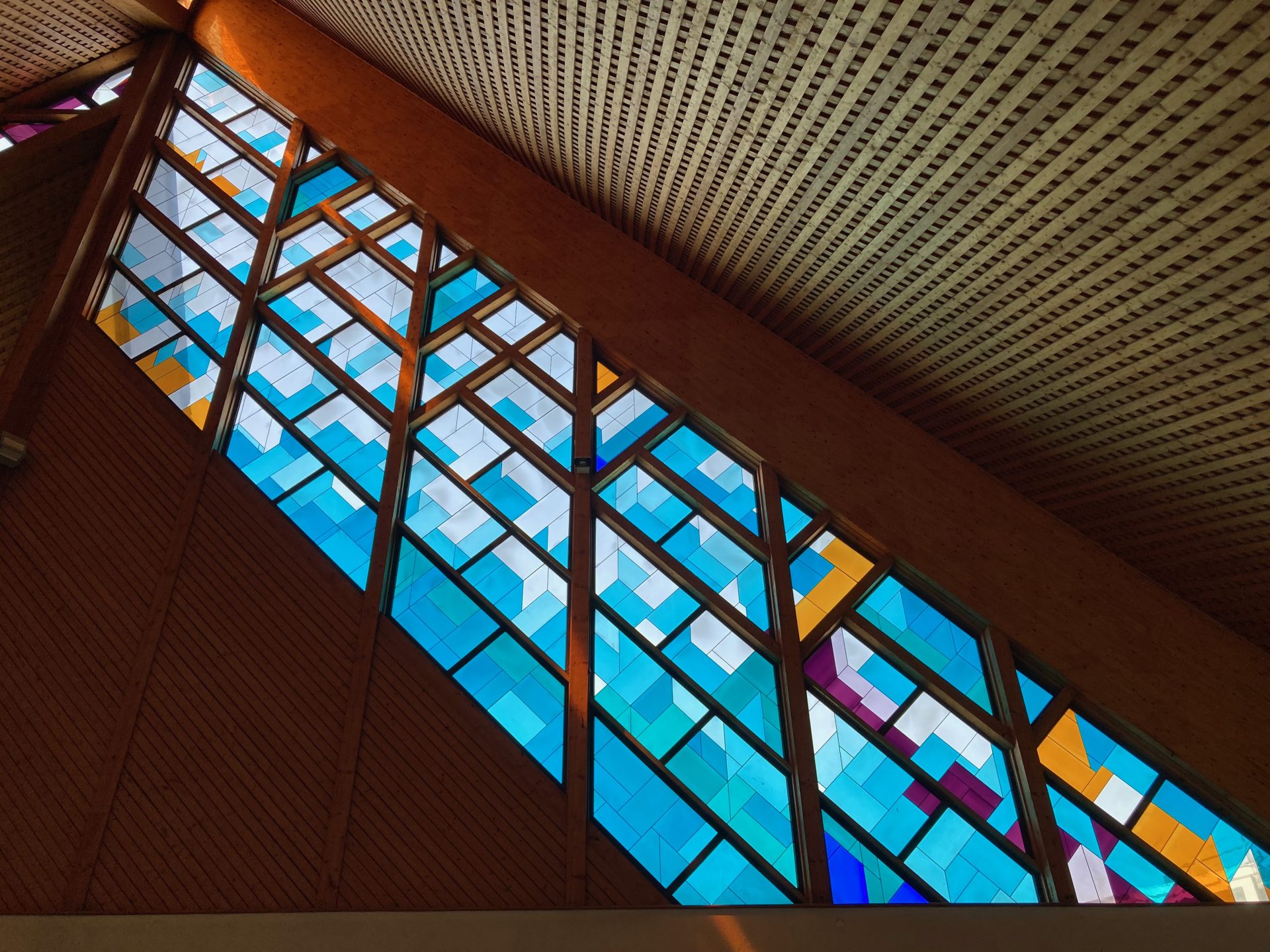
The Prague Archbishopric reacted quickly to its newfound freedom. As early as the spring of 1990, it announced a public, anonymous competition for the construction of a church. The winning design was by architect Jindřich Synek, who transformed the original rectory, connecting wing, and church into a functional complex with a seating capacity of 230. The original parish chapel was transformed into the Miriam Theatre, a hall with a capacity of up to 100 spectators.
The architectural design was to some extent predetermined by the almost square plot, but Jindřich Synek was able to use this to the benefit of the overall impression. As a result, the building’s exterior shape evokes the image of a tent, recalling the Old Testament story of the Jews’ journey through the desert.
The foundation stone was personally blessed by Pope John Paul II during his first visit to the then Czechoslovakia in April 1990. In November 1992, the construction site was blessed, and construction began; the church was completed in 1994 and consecrated in June 1994.
Look how beautiful this church is.